Brushed vs brushless RC cars: which should you buy?
Brushed cars are cheaper, slower and simpler; brushless cars are faster, more efficient and need less upkeep. Here is how to decide which one fits your budget, your space and the person driving it.
Updated 7 November 2026 · 8 min read
What is the difference between brushed and brushless?
The difference is how the motor switches its magnetic field: a brushed motor does it mechanically with carbon brushes rubbing on a spinning commutator, while a brushless motor has no brushes and lets the electronic speed controller (ESC) do the switching. Everything else, speed, run time, wear and price, follows from that one design choice.
In a brushed motor the coils spin inside a can lined with fixed magnets. Two spring-loaded brushes feed current to the spinning part, and because they are always in contact they create friction, heat and a little electrical noise. They also wear down over time. Brushed motors in budget cars are usually the familiar 390 or 540 size cans.
In a brushless motor the layout is turned inside out: the magnets spin and the coils stay still. With nothing rubbing, there is less wasted energy and nothing to wear apart from the bearings. The catch is that a brushless motor cannot run without a matching brushless ESC, which times the current to each coil. Brushless motors are rated in kV (rpm per volt with no load), so a 3000kV motor on a 7.4V battery spins at roughly 22,000 rpm unloaded.
Is brushless faster than brushed?
Yes, at the same scale and price a brushless car is nearly always faster, often by a big margin. Brushless motors convert more of the battery's energy into movement and can safely spin faster, and they are normally paired with LiPo batteries that hold their voltage better under load.
Some manufacturer-claimed figures from our own range show the gap. The WL Toys 144016, a 1/14 brushed buggy, is rated at around 35km/h. The WLtoys 144010, a brushless car of similar size, is rated at around 75km/h. Rlaarlo's XTS-P12 rally car claims 80km/h on 3S LiPo. Treat every top-speed claim as a best case on smooth tarmac with a fresh battery; on grass you will see a good deal less.
Speed is not automatically a good thing. A 70km/h car in a small garden spends most of its time hitting fences, and the faster a car goes the more it breaks when it crashes. For younger drivers or tight spaces, a brushed car's gentler pace is often the better experience.
Does brushless give longer run times?
Brushless gives more running per charge at the same pace, because less energy is lost as heat, but most people drive brushless cars harder and so the real-world difference is smaller than you might expect. Run time depends far more on battery capacity (mAh), the weight of the car and how much you use full throttle.
As a rough guide, budget 1/16 to 1/12 bashers on the supplied pack typically give somewhere between eight and fifteen minutes of hard driving, and crawlers driven slowly last much longer. The easiest way to drive for longer is a second battery, which we cover in our batteries and chargers guide.
Which needs more maintenance?
Brushed motors need more maintenance, because the brushes and commutator wear and the motor eventually loses power and needs replacing. Brushless motors are close to maintenance-free: keep the bearings clean and do not let the motor overheat.
In practice, a brushed motor in a budget car is cheap to replace, so most owners simply swap it when it gets tired rather than servicing it. The bigger maintenance difference is in the rest of the car. Brushless power puts much more stress on gears, driveshafts, diff internals and tyres, and a fast car crashes harder. Expect to buy more drivetrain and suspension parts for a brushless basher than for a brushed one.
- Brushed: check for a hot or smelly motor, replace the motor when performance drops, keep the gear mesh correct.
- Brushless: watch motor and ESC temperatures, check the pinion grub screw, inspect drive cups and dogbones after big crashes.
- Both: dry the car after wet runs, check wheel nuts and screws, and clean out grass and grit from the gears.
How much more does brushless cost?
At the budget end the gap is often only £30 to £50, because several makers sell the same chassis in brushed and brushless versions. Three clear examples in our range come from FTX, Maverick and Blackzon.
| Model | Brushed | Brushless |
|---|---|---|
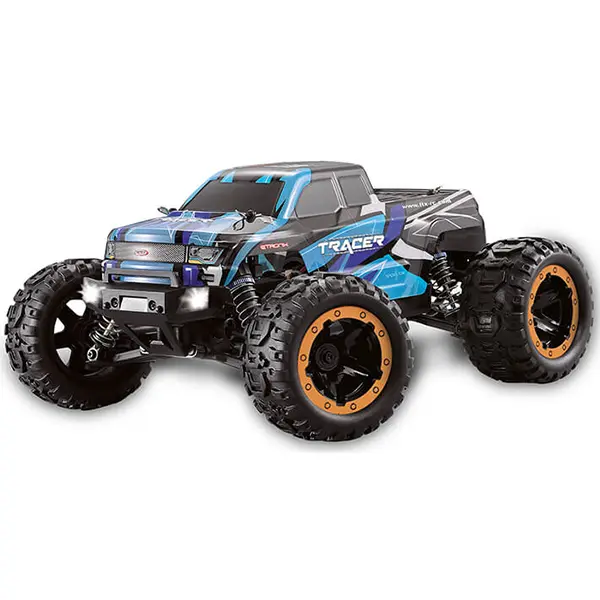
| FTX Tracer 1/16 monster truck | £74.99 | £119.99 |
| Maverick Qbit MT 1/16 monster truck | £74.99 | £124.99 (Flux) |
| Blackzon Vyper SC 1/16 short course | £89.99 | £119.99 (Turbo) |
The running costs tilt the same way. Brushless cars eat parts and tyres faster, and you may want a better charger and spare LiPos. A brushed car with a spare battery is still the cheapest way into hobby-grade RC.
What is the difference between sensored and sensorless brushless?
A sensored brushless motor has a small sensor cable that tells the ESC exactly where the rotor is, giving smooth, precise control from a standstill; a sensorless motor has no sensor and the ESC has to estimate the rotor position, which works well at speed but can stutter (cog) at very low speed.
Almost every budget brushless basher is sensorless, and for jumping around a park that is fine. Sensored systems matter when fine low-speed control matters: racing, drifting and rock crawling. You will find them on cars such as the HPI Stage-D10 Flux drift car and MJX's 1/10 Hyper Go 10303 rally car. Sensorless systems are simpler and slightly more robust in mud and water, since there is no extra cable to damage.
Who should buy a brushed RC car?
A brushed car suits younger drivers, complete beginners, smaller gardens and anyone on a tight budget. It is slow enough to learn steering and throttle control, cheap to repair, and less likely to cause damage to itself or anything it hits.
Brushed cars to start with



Who should buy a brushless RC car?
A brushless car suits teenagers and adults who already know the basics, or who have a large space such as a park, field or empty car park. If you want jumps, speed runs and a car that still feels quick after the novelty wears off, brushless is worth the extra money.
Budget brushless cars
 Save 23%
WLtoys 144010 1/14 Scale 4WD Brushless RC Car
£99.99£129.99
 Save 21%
MJX HYPER GO 16207 3S 1/16 Brushless High Speed RC Car Vechile Models 45km/h
£99.99£125.99
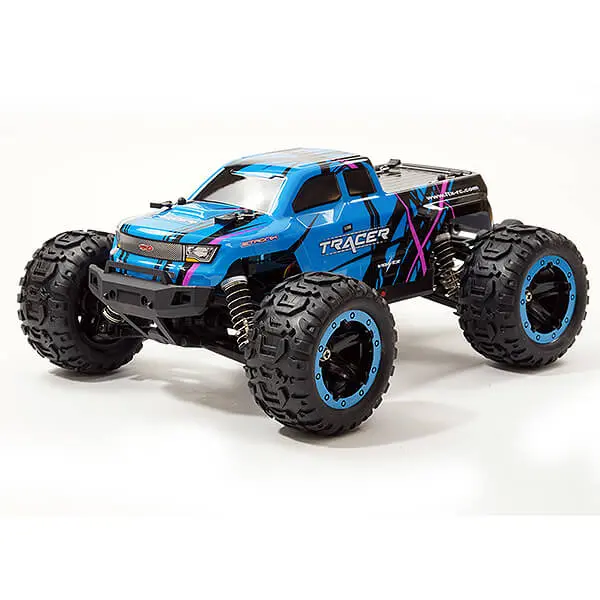
FTX Tracer 1/16 4WD Brushless Monster Truck RTR – Blue
£119.99

Maverick RC Qbit MT Flux 1/16th Monster Truck - Blue
£124.99
 Save 35%
Rlaarlo AM-X12 High Performance RC Car (Blue)
£116.99£179.99
 Save 17%
Rlaarlo XTS-P12 RC Rally car 1/12 Metal Brushless 4WD RTR - Red
£149.99£179.99
Free UK delivery
Can I upgrade a brushed car to brushless later?
Often yes, but it is not always worth it on the cheapest cars. A conversion needs a brushless motor and a matching ESC, ideally bought together as a motor and ESC combo, plus a LiPo battery and possibly a different pinion gear.
The weak point is usually the drivetrain. Plastic gears, diffs and driveshafts built for a brushed motor can strip quickly under brushless power. If a car is sold in both versions, as the FTX Tracer and Maverick Qbit are, the brushless version often has stronger parts, so buying it outright tends to work out cheaper than converting. If you do convert, check the brand's spare parts for metal upgrades first.
Going the other way is also an option: some drivers buy brushless for its efficiency and simply drive gently, or use a radio with throttle limiting while a child learns.
Brushed vs brushless at a glance
| Brushed | Brushless | |
|---|---|---|
| Budget prices in our range | From about £35 (mini) or £45 (1/14) | From about £70; most around £100 to £150 |
| Speed | Moderate, good for learning | Much faster at the same size |
| Efficiency | Lower; more energy lost as heat | Higher; more of the battery reaches the wheels |
| Motor wear | Brushes wear out | Only bearings wear |
| Wear on the rest of the car | Lower | Higher; more broken parts |
| Low-speed control | Smooth | Smooth if sensored; can cog if sensorless |
| Best for | Kids, beginners, small gardens | Experienced drivers, big open spaces |
Questions we get asked
- Is brushless always better than brushed?
- No. Brushless is faster and more efficient, but a brushed car is cheaper, easier to control and cheaper to repair, which makes it the better choice for young children and small spaces.
- How do I tell if my RC car is brushed or brushless?
- A brushed motor usually has two wires; a brushless motor has three thick wires, plus a thin multi-wire sensor cable if it is sensored. The product listing or the label on the ESC will normally say too.
- Do brushless RC cars need LiPo batteries?
- Not strictly, but nearly all budget brushless cars are designed around LiPo and come with one. See our batteries and chargers guide for how to use them safely.
- Are brushless RC cars waterproof?
- Brushless motors cope with water better than brushed ones because there are no brushes, but water resistance depends on the ESC and receiver. Check the listing for a waterproof or splash-proof ESC and always dry the car after wet runs.
- What does kV mean on a brushless motor?
- kV is the number of rpm the motor turns per volt with no load. A higher kV spins faster but with less torque, so it suits lighter, smaller cars or flat-out speed; a lower kV suits heavier trucks.
- Is a sensored motor worth it for a basher?
- Usually not. Sensored systems give smoother low-speed control, which matters for racing, drifting and crawling. For general bashing a sensorless system is simpler and works well.