RC car batteries and chargers: a plain-English guide
The battery decides how fast your RC car goes, how long it runs and how safely you can charge it. This guide explains the labels, the plugs and the habits that keep packs healthy, without the jargon.
Updated 7 November 2026 · 10 min read
Should I use NiMH or LiPo in my RC car?
For most modern hobby-grade RC cars, LiPo is the better choice because it is lighter, holds its voltage better and gives more punch and run time for its size; NiMH is the safer, more forgiving option for younger drivers and cars designed around it. Always use the battery type your car's speed controller (ESC) is designed for.
NiMH (nickel-metal hydride) packs are made of 1.2V cells, so a common six-cell car pack is 7.2V. They tolerate rough handling, do not need balance charging and are hard to damage by running flat. The downsides are weight, a voltage that sags as the pack empties, and slow self-discharge, so a pack charged last week will not be full today.
LiPo (lithium polymer) packs are made of 3.7V nominal cells, charged to 4.2V per cell when full. They are lighter and stronger, and nearly every budget brushless car now ships with one. They need more care: they must be balance charged on a LiPo charger, must not be run completely flat, and can catch fire if punctured, overcharged or damaged. Many cheaper ready-to-run cars also ship with Li-ion packs, which use similar cells and need the same lithium charging and safety rules.
| NiMH | LiPo | |
|---|---|---|
| Voltage per cell | 1.2V | 3.7V nominal, 4.2V full |
| Weight | Heavier | Lighter for the same energy |
| Power under load | Fades as it empties | Stays strong until near empty |
| Charging | Any NiMH charger | LiPo charger with balance lead |
| Storage | Forgiving | Store at about 3.8V per cell |
| Fire risk | Low | Real if abused; follow safety rules |
What do 2S and 3S mean?
The number before the S is how many LiPo cells are connected in series: 2S means two cells at 7.4V nominal and 3S means three cells at 11.1V nominal. More cells means more voltage, and more voltage means a faster motor.
Only fit a 3S pack if your car and ESC are rated for it. Many budget brushless cars are sold as 2S and 3S compatible, such as MJX's Hyper Go 1/16 trucks, which are rated for up to 67km/h on 3S. Putting 3S into a 2S-only ESC can destroy it instantly. On a 2S/3S car, start on 2S while you learn; the extra speed of 3S also means harder crashes and more broken parts.
| Pack | Cells | Nominal voltage | Full charge |
|---|---|---|---|
| 1S | 1 | 3.7V | 4.2V |
| 2S | 2 | 7.4V | 8.4V |
| 3S | 3 | 11.1V | 12.6V |
| 4S | 4 | 14.8V | 16.8V |
What does mAh mean on an RC battery?
mAh (milliamp-hours) is the battery's capacity, or how much energy it holds: a 2200mAh pack holds roughly twice as much as an 1100mAh pack and will run about twice as long in the same car. Higher capacity usually means a bigger, heavier pack, so it has to fit the battery tray.
Budget 1/16 to 1/12 cars commonly come with packs of around a couple of thousand mAh, such as the 2000mAh pack in the WLtoys 124008, while minis such as 1/28 cars use much smaller packs, for example 400mAh on the WL Toys 284161. When buying a bigger pack, measure your battery tray first and check the weight; a much heavier pack can make a small car handle badly.
What does the C rating mean?
The C rating tells you how quickly a LiPo can safely release its energy, as a multiple of its capacity: multiply the C rating by the capacity in amp-hours to get the maximum continuous current. A 2200mAh 30C pack can in theory deliver 2.2 × 30 = 66 amps.
For a budget car, almost any reputable pack of 25C or more is plenty. C ratings are not tested to a common standard, and figures on cheap packs are often optimistic, so a higher number on the label is not a reliable guide to a better battery. Buy from a known brand and match or exceed the rating of the pack your car came with.
Which battery connector do I need?
You need the same connector as your car's ESC, or a properly made adapter; the battery and the car must have matching plugs for the car to work. The main lead carries the power, and LiPo packs also have a thin balance lead used only for charging.
| Connector | Where you will see it | Notes |
|---|---|---|
| T-plug (Deans) | Older and many budget 1/16 to 1/10 cars | Flat T-shaped pins; can be stiff to unplug, so grip the plug, not the wires |
| XT60 | Many 2S and 3S cars, and most hobby chargers | Yellow, keyed so it only fits one way |
| XT30 | Small cars and mini packs | A smaller XT60; not for big current draws |
| EC5 | Larger and more powerful cars, often 1/8 | Blue, bullet-style contacts for higher current |
| Tamiya | Older NiMH cars | Widely used but not designed for brushless current |
| Small two-pin plugs | 1/28 and 1/24 minis | Varies by brand; buy the maker's own spare pack |
Connectors matter because a poor or undersized plug adds resistance, which wastes power as heat and can melt the plug in a powerful car. Adapters are fine for occasional use, but if you swap often it is better to standardise all your packs on one plug. Soldering new plugs is a basic RC skill, but only do it if you are confident: a short circuit on a LiPo can start a fire.
What is balance charging?
Balance charging means charging a LiPo while the charger monitors every cell through the balance lead, so each cell finishes at the same voltage. Without it, one cell can end up overcharged while another is undercharged, which shortens the pack's life and raises the fire risk.
Always use balance mode on a LiPo, set the correct chemistry (LiPo, not NiMH or Li-ion HV unless the pack says so) and the correct cell count. A sensible default charge rate is 1C, meaning the capacity in amps: charge a 2200mAh pack at 2.2A unless the battery maker says otherwise.
Many budget ready-to-run cars include a small USB balance charger. These are safe when used as instructed but slow, and charging one pack can take a couple of hours. A hobby charger with an XT60 output, adjustable current and a storage mode is the first upgrade most owners make. Have a look at our batteries and chargers range.
What is a LiPo storage charge?
A storage charge leaves each cell at about 3.8V, roughly half full, which is the level at which a LiPo ages most slowly. If you will not use a pack for more than a few days, put it on the charger's storage setting rather than leaving it full or flat.
- Do not leave LiPos fully charged for long periods; it ages them and makes them swell.
- Do not store them flat; a cell that drops too low may never charge safely again.
- Store at room temperature in a LiPo bag or metal box, away from anything flammable, not in a hot car or a freezing shed.
- Unplug packs from the car after every run. Many ESCs draw a small current even when switched off and can drain a pack below a safe level.
How do I use LiPo batteries safely at home?
Charge LiPos on a non-flammable surface, inside a LiPo safety bag, with the correct charger settings, and never leave them charging unattended or overnight. UK fire services give the same core advice for all lithium batteries: do not charge while you are out or asleep, use the correct charger, and do not cover batteries or chargers while charging.
- Stay with it. Charge where you can see and smell the pack, and have a working smoke alarm in that room.
- Use a LiPo bag or a fire-resistant box, on a tiled floor, concrete or a metal tray, away from curtains and sofas.
- Let packs cool before charging and after driving. A pack too hot to hold comfortably needs to rest.
- Retire damaged packs. A swollen (puffy), dented or punctured LiPo should not be charged or used again. Move it outdoors to a safe spot away from anything flammable.
- Respect the low-voltage cut-off. Set your ESC to LiPo mode so it cuts power before the cells drop too low, and stop driving when the car slows.
- Keep packs away from children when charging, and supervise younger drivers handling batteries.
How long will an RC car battery last?
A typical budget 1/16 to 1/12 basher runs for roughly eight to fifteen minutes on its supplied pack when driven hard, and noticeably longer at gentler speeds. Crawlers driven slowly can last much longer, and fast brushless cars on 3S tend to sit at the shorter end.
Run time depends on capacity, the weight of the car, the surface (long grass is hard work), tyre size and how much time you spend at full throttle. Over its life, a well-treated LiPo should give hundreds of cycles, but it will lose capacity faster if it is regularly run flat, stored full or charged hot. The simplest way to drive for longer is to own two or three packs and swap them while one cools and charges.
What spare battery should I buy for my budget car?
Buy a spare that matches the label on the pack your car came with: the same chemistry, voltage (cell count), connector and physical size, with similar or higher capacity and C rating. The label usually shows all of this; if in doubt, copy it exactly.
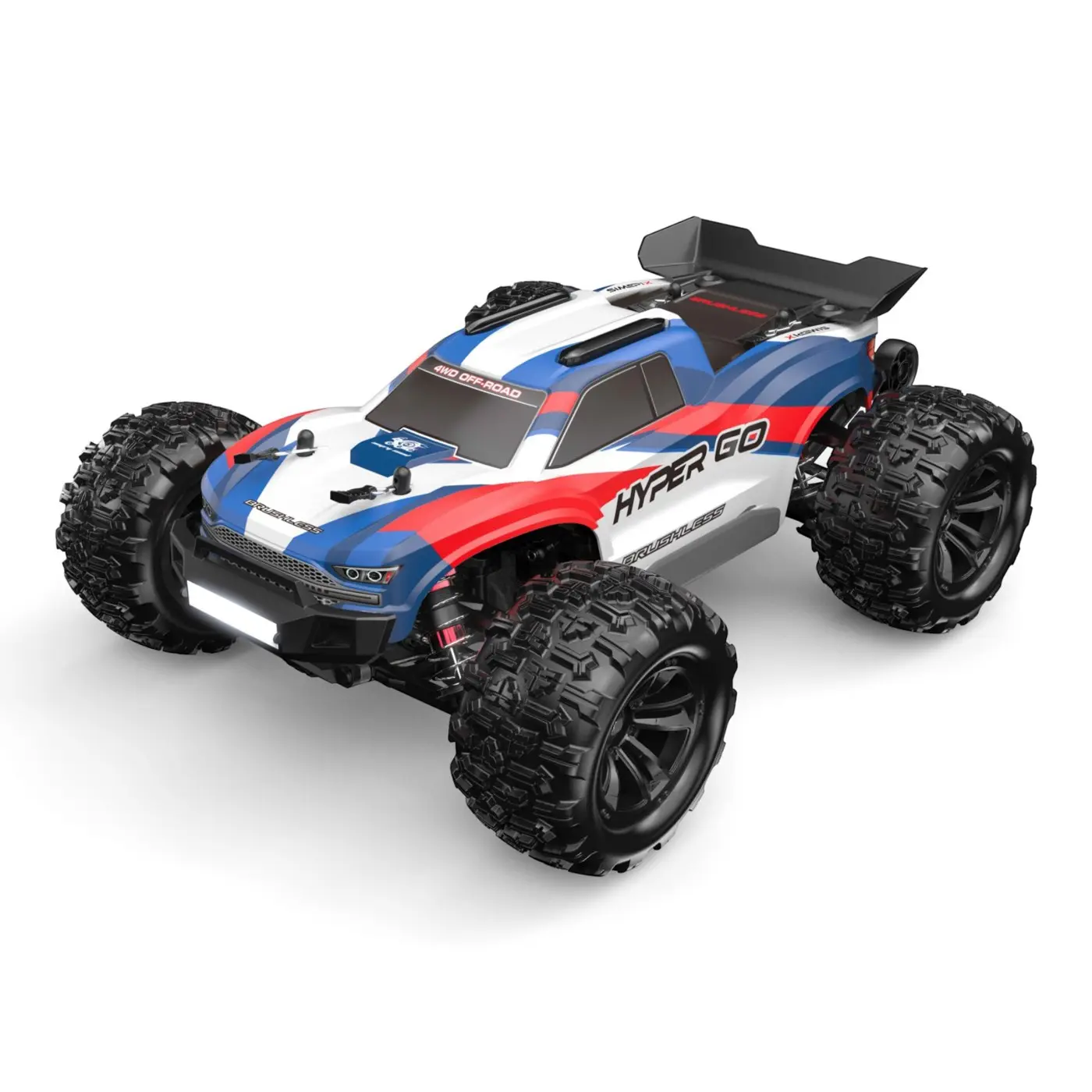
- MJX Hyper Go. The 1/16 and 1/14 brushless cars ship with a LiPo, and several, such as the 16207 and 16212, are listed for 3S. Check the label on your pack for voltage and plug, and measure the tray before buying a larger capacity. See MJX RC parts and the MJX range.
- Rlaarlo. The AM-X12 buggy comes with a 2S pack and the XTS-P12 rally car is set up for 3S, so they are not interchangeable without checking the ESC. Some Rlaarlo cars, such as the 1/14 XDKJ-001, include two packs in the box. See Rlaarlo parts and the Rlaarlo range.
- WLtoys. Many of the 1/12 cars, such as the 124017 and 124018, come with a 7.4V (2S) pack. The 1/28 minis use much smaller 7.4V packs, so check the plug and size before ordering a spare. See the WLtoys range.
Whatever you buy, a second battery is the single most useful accessory for any RC car. If your car came with a slow USB charger, a hobby charger with balance and storage modes is the next best purchase.
Budget cars mentioned in this guide
 Save 21%
MJX HYPER GO 16207 3S 1/16 Brushless High Speed RC Car Vechile Models 45km/h
£99.99£125.99
 Pre-order
MJX Hyper Go 16212 1/16 Brushless 4WD RC Truck
£119.99
 Save 35%
Rlaarlo AM-X12 High Performance RC Car (Blue)
£116.99£179.99
 Save 17%
Rlaarlo XTS-P12 RC Rally car 1/12 Metal Brushless 4WD RTR - Red
£149.99£179.99
Free UK delivery
 Save 40%
Rlaarlo 1/14 Brushed RC Buggy 60 KMH RTR, XDKJ-001 cyan
£87.99£145.99
 Save 23%
WLtoys 144010 1/14 Scale 4WD Brushless RC Car
£99.99£129.99

WLToys 124017 V2 1/12th Racing buggy
£129.99
Free UK delivery
Not sure whether you need brushed or brushless power in the first place? Our brushed vs brushless guide covers the difference. Orders over £129.99 qualify for free UK delivery, and everything is dispatched from UK stock.
Questions we get asked
- Can I charge a LiPo with a NiMH charger?
- No. LiPo packs need a charger with a LiPo mode that stops at 4.2V per cell and balances the cells. Charging a LiPo on a NiMH setting can overcharge it and start a fire.
- Can I put a 3S LiPo in a 2S RC car?
- Only if the ESC and motor are rated for 3S. Check the manual or the label on the ESC. Running 3S on a 2S-only system can destroy the ESC immediately.
- Is it safe to charge RC batteries overnight?
- No. UK fire services advise against charging lithium batteries while you are asleep or out. Charge where you can keep an eye on the pack, ideally inside a LiPo bag on a non-flammable surface.
- Does a higher mAh battery make my RC car faster?
- Not really. Higher mAh means longer run time. Speed comes mainly from voltage (2S vs 3S), although a higher capacity pack may hold its voltage slightly better under load.
- What should I do with a puffy LiPo battery?
- Stop using and charging it straight away. Move it outdoors to a safe place away from anything flammable, tape the connectors and take it to a household waste recycling centre. Do not put it in the bin.
- How long does it take to charge an RC car battery?
- At the standard 1C rate, a flat LiPo takes roughly an hour. Small USB chargers supplied with budget cars charge more slowly and can take a couple of hours.