RC car scales explained (1/28 to 1/5)
Scale tells you roughly how big an RC car is compared with the real thing. Here is what each common scale means in practice: size, where it works best, what it costs and how easy it is to keep running.
Updated 7 November 2026 · 8 min read
What does RC car scale mean?
Scale is the ratio between the model and a full-size vehicle, so a 1/10 car is meant to be one tenth the size of the real one and a 1/28 car one twenty-eighth. The bigger the number after the slash, the smaller the car.
In practice scale is a loose label rather than a precise measurement. A 1/10 monster truck is far bigger than a 1/10 touring car, because real monster trucks are bigger than real saloon cars. Some budget brands also round their numbers: a car sold as 1/14 can be close in size to another brand's 1/12. When space or storage matters, check the length in the product description rather than relying on the scale alone.
How big is each RC car scale?
Most RC cars fall between about 15cm long at 1/28 and over 80cm long at 1/5. The table below gives typical lengths, uses and the price spread for ready-to-run cars in our catalogue at the time of writing.
| Scale | Typical length | Typical use | Where to drive | Our price range |
|---|---|---|---|---|
| 1/28 | 15 to 18cm | Mini drift and racing cars | Indoors, hard floors, small tracks | About £35 to £210 |
| 1/24 | 16 to 22cm | Mini crawlers, rally cars, buggies | Indoors, patios, a small garden | About £65 to £140 |
| 1/18 | 22 to 30cm | Crawlers, small trucks | Garden, rockery, indoor crawl course | About £60 to £260 |
| 1/16 | 25 to 32cm | Budget bashers, monster trucks | Garden, short grass, park paths | About £65 to £160 |
| 1/14 | 28 to 35cm | Budget buggies, drift and rally cars | Garden, park, car park | About £45 to £180 |
| 1/12 | 30 to 40cm | Fast budget buggies and trucks | Park, field, BMX track | About £85 to £275 |
| 1/10 | 38 to 55cm | The hobby standard: everything | Park, field, club track | About £65 to £590 |
| 1/8 | 48 to 60cm | Racing buggies, big bashers | Open fields, tracks, skate parks | About £170 to £740 |
| 1/7 | 60cm and up | Large rally cars and trucks | Big open spaces | About £440 to £660 |
| 1/5 | 80cm and up | Giant buggies, often petrol | Large open land with permission | From about £675 (kit) |
For a sense of the extremes: a bodied Kyosho Mini-Z at 1/28 is listed at roughly 17 to 18cm long, about the length of a phone, while HPI's Baja 5B at 1/5 is about 82cm long. Prices at the top of the 1/10 and 1/8 ranges include unassembled kits that need a motor, battery and radio added.
What scale RC car is best for a garden?
For a typical UK garden, a 1/16 or 1/14 car is the best fit: big enough to cope with lawn grass, small enough not to hit the fence every two seconds. A 1/18 crawler is also a good garden choice if you have borders, rockeries or a patio to climb.
Grass is the deciding factor. Very small cars, 1/24 and below, struggle in anything longer than a freshly mown lawn because their ground clearance is only a centimetre or two. Large 1/10 and 1/8 cars cope with long grass easily but are too fast for most gardens and can damage plants, pets' nerves and patio doors. If your garden is small and mostly paved, a 1/24 rally car or a 1/18 crawler is more fun than a fast 1/16 truck.
What scale is best for a park?
For a park or playing field, 1/12 to 1/10 is the sweet spot, with 1/8 worth considering if you have plenty of room and budget. Larger cars handle rough grass, bumps and jumps far better, and they are easier to see at a distance.
Be considerate in public spaces. Drive away from people, dogs and children, check any local byelaws, and keep speeds sensible on shared paths. A fast 1/10 basher can hit 60km/h or more, which is quick enough to hurt someone.
What scale works indoors?
Indoors, 1/28 and 1/24 are the only scales that really work. They fit in a living room or hallway, can run on carpet or hard floors, and are light enough not to mark the skirting boards.
At 1/28, the Kyosho Mini-Z range is the precision option, with proper suspension and tuning parts, while the WLtoys 284131 is a cheap way to try mini drifting. At 1/24, crawlers such as the WL Toys 2428 and FTX Outback Mini 3.0 are good fun over books and cushions, and the Maverick Microbe is a small buggy that suits a hallway or patio.
Small scales for indoors and patios
 Save 30%
WLtoys 284131 is a 1/28 scale 4WD RC drift truck
£34.99£49.99

WL Toys 2428 1/24th scale mini rock crawler
£64.99
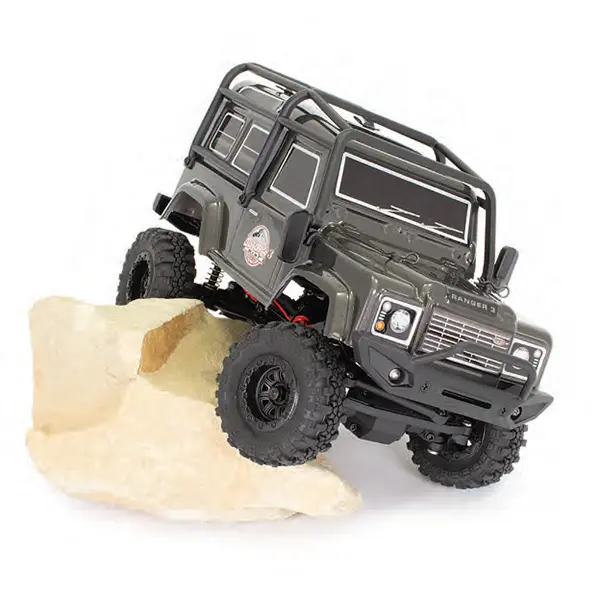
FTX Outback Mini 3.0 Ranger 1:24 Ready-To-Run – Dark Grey
£84.99

Maverick RC Microbe 1/24th Buggy - Blue
£89.99

Kyosho Mini-Z MR04 RWD Porsche 911 GT3 RS Orange (N-Rm/Kt531p)
£186.99
Free UK delivery
Why do 1/16 and 1/14 dominate budget bashers?
1/16 and 1/14 dominate because they are the smallest size that still copes with grass and jumps, and the largest size that can be built cheaply with small motors, small batteries and plastic parts. That combination lets makers such as MJX, WLtoys, Rlaarlo, FTX and Maverick sell a 4WD car with oil-filled shocks for under £100.
- Cheaper electronics. Smaller cars need smaller motors, ESCs and servos, and run happily on compact 2S or 3S LiPo packs.
- Cheaper materials and shipping. Less plastic and metal, smaller boxes, lower freight costs.
- Shared platforms. One chassis is often sold as a buggy, truck and short course truck, so tooling costs are spread across several models.
- Easy to live with. They fit in a car boot or a cupboard, and they are quick enough to be exciting without needing a full-size field.
The trade-off is durability. A 1/16 car's parts are smaller and lighter, and with brushless power they break more often than a 1/10 car's. That is fine as long as spares are easy to get, which brings us to the next point.
Popular 1/16 and 1/14 bashers
 Save 21%
MJX HYPER GO 16207 3S 1/16 Brushless High Speed RC Car Vechile Models 45km/h
£99.99£125.99
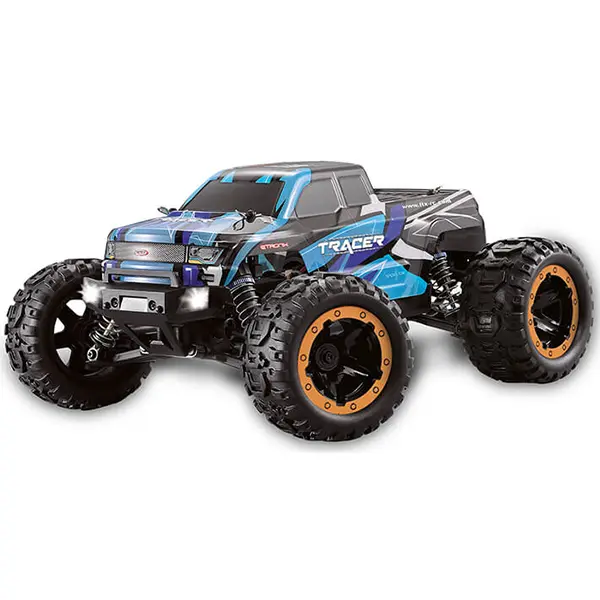
FTX Tracer 1/16 4WD Monster Truck RTR – Blue
£74.99

Maverick RC Qbit MT 1/16th Monster Truck - Blue
£74.99
 Save 23%
WLtoys 144010 1/14 Scale 4WD Brushless RC Car
£99.99£129.99
 Save 25%
WL Toys 144016 Brushed RC Buggy
£44.99£59.99
 Save 18%
MJX Hyper GO 14301 Brushless 1/14 RC Car - High Performance, 4WD Remote Control
£119.99£145.99
How does scale affect spare parts?
Scale itself matters less for spares than brand and model: parts are made for a specific chassis, not for a scale, so a 1/16 arm from one maker will not fit another maker's 1/16 car. Before buying, check that the brand has a spares range you can actually order from.
1/10 is the best-supported scale overall, with the widest choice of tyres, bodies, motors and upgrade parts that fit across many cars, because standard parts such as 12mm wheel hexes and 540-size motors are common there. Smaller budget cars mostly rely on the maker's own parts. We stock dedicated ranges for MJX RC parts, Rlaarlo parts, FTX parts, Maverick parts, UDI RC parts and Mini-Z parts, among others in parts by brand.
When does 1/8, 1/7 or 1/5 make sense?
Large scales make sense when you have a big open space, a bigger budget and some experience. A 1/8 buggy or truck soaks up rough ground and big jumps, and 1/8 is a long-established racing class.
The running costs rise with size. Larger cars use 4S to 8S LiPo setups, bigger chargers and more expensive tyres, and at 1/5 many cars are petrol-powered. Kits such as the HPI Baja 5B Flux also need you to supply the electronics. These are rewarding cars, but they are not budget cars once everything is added up.
Which scale should I choose?
Choose by where you will drive first and budget second. As a quick rule: indoors means 1/28 or 1/24, a garden means 1/18 to 1/14, a park means 1/12 to 1/10, and a big field or track means 1/10 or 1/8.
If you are also deciding between motor types, our brushed vs brushless guide explains how speed and durability change. Free UK delivery applies to orders over £129.99, and all stock ships from the UK.
Questions we get asked
- Is 1/10 bigger than 1/16?
- Yes. The larger the number after the slash, the smaller the car, so a 1/10 car is bigger than a 1/16 car and a 1/28 car is smaller still.
- What is the most popular RC car scale?
- 1/10 is the most widely supported hobby scale, with the most models and aftermarket parts. In the budget market, 1/16 and 1/14 are the most common because they are cheap to build and still cope with grass.
- What scale RC car is best for a child?
- For children, 1/16 to 1/18 is usually best outdoors and 1/24 indoors. Look for a brushed motor or a speed limiter. Our RC cars for kids guide has specific picks.
- Can a 1/24 RC car drive on grass?
- Only on short, dry, freshly cut grass. Most 1/24 cars have very little ground clearance, so they are happiest on hard surfaces, carpet or crawl courses.
- Do parts from one 1/16 car fit another?
- Usually not across brands. Parts are designed for a specific chassis, so buy spares made for your exact model. Within a brand, cars that share a platform often share many parts.
- Are all cars of the same scale the same size?
- No. Scale is relative to the real vehicle, so a 1/10 monster truck is much bigger than a 1/10 touring car, and makers round their figures. Check the stated length when size matters.